

Textiles to toys, diamonds to data centres: How Indo-US FTA reshapes export landscape
Tariff relief across $86 billion of exports strengthens India’s competitiveness in the US market
Textiles to toys, diamonds to data centres: How Indo-US FTA reshapes export landscape
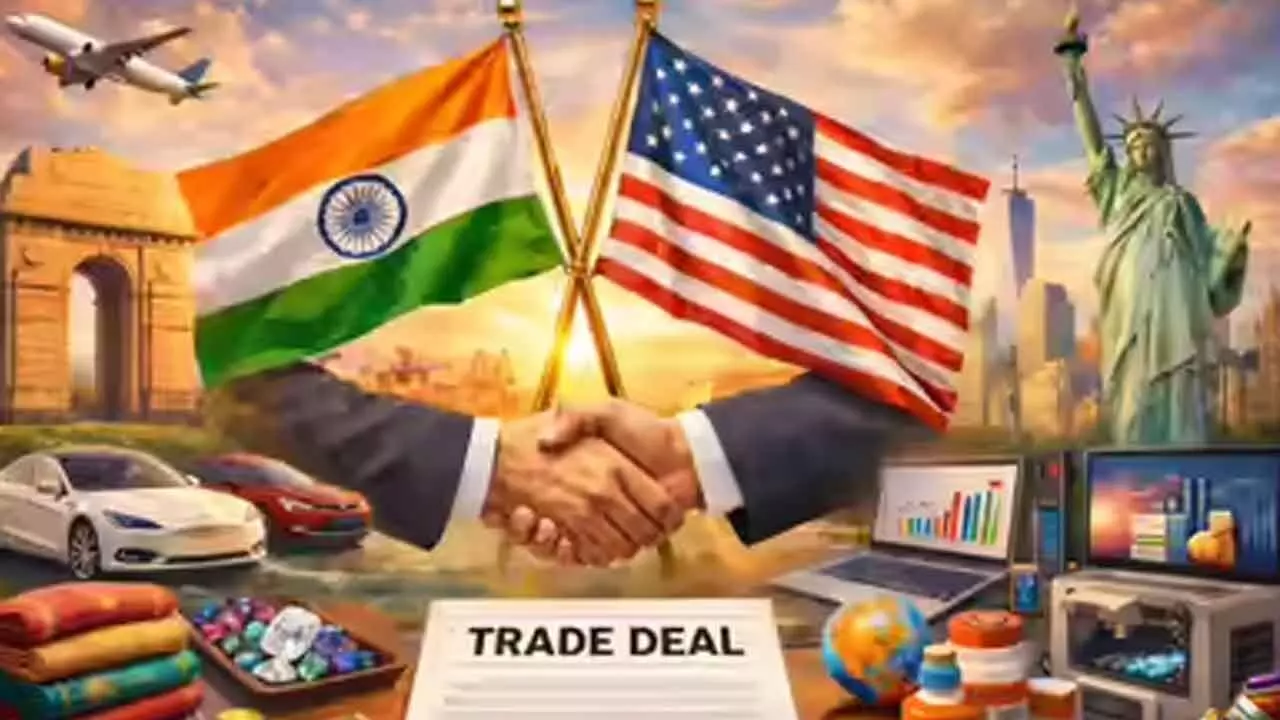
The India–US Trade Deal is an interim bilateral agreement aimed at reducing tariff barriers and expanding market access between the two countries. Under the arrangement, India receives a preferential reciprocal tariff rate of 18% on most goods entering the United States, down from earlier levels of up to 50%.
The United States has eliminated tariffs entirely on select categories, including generic pharmaceuticals, gems and diamonds, and aircraft parts. In return, India has agreed to eliminate or reduce duties on several US industrial and agricultural products, including tree nuts, processed fruits, soybean oil, wine, and spirits.
The agreement lays the groundwork for a broader Bilateral Trade Agreement (BTA) currently under negotiation. It covers Indian exports worth $86.35 billion to the US and establishes rules of origin, addresses non-tariff barriers, and commits both countries to cooperation in digital trade.
Of India’s $86.35 billion exports to the US in 2024, $40.96 billion were subject to reciprocal tariffs. Under the new framework, $30.94 billion worth of exports see tariffs reduced from 50% to 18%, while $10.03 billion gain zero-tariff access. Another $1.04 billion remains exempt, and $28.30 billion of exports covered under Section 232 provisions gain zero additional duty access.
This restructuring delivers significant cost advantages to Indian exporters across textiles, leather, machinery, and consumer goods.
Textiles and Employment Boost
Tariffs on textile exports fall from 50% to 18%, with silk receiving zero-duty access. This opens greater opportunities in a US textile market valued at $113 billion. Key beneficiary segments include readymade garments, carpets, cotton and man-made textiles, bedspreads, yarn, baby clothing, bed linen, blankets, and gloves.
Given India’s large production base and competitive labour costs, the tariff cut enhances its ability to capture market share from competitors facing higher duties. With millions employed across textile clusters, the agreement is expected to have a positive impact on employment generation.
Leather and Footwear Gains
Leather and footwear exports also benefit from tariff reductions from 50% to 18%, improving access to a $42 billion US market. India’s labour-intensive leather industry, concentrated in Tamil Nadu and Uttar Pradesh, stands to gain across finished leather, footwear, and components, strengthening India’s position against competitors such as Vietnam and China.
Gems and Jewellery Advantage
Tariffs on gems and jewellery exports are reduced from 50% to 18%, providing access to a $61 billion US market. Additionally, diamonds, platinum, and coins receive zero-duty access, covering a $29 billion segment.
India processes nearly 90% of the world’s diamonds by volume. Zero-duty access for cut and polished diamonds, lab-grown diamonds, and coloured gemstones further enhances India’s competitiveness in this high-value sector.
Agriculture and Industrial Exports
The US grants zero additional duty access to $1.36 billion worth of Indian agricultural exports. Beneficiaries include spices, tea and coffee extracts, coconut products, tree nuts, fruits, mushrooms, processed foods, bakery products, sesame, poppy seeds, among others. Of this, $1.035 billion receives assured zero reciprocal tariff treatment, offering stability to farmers and exporters. India currently enjoys a $1.3 billion agricultural trade surplus with the US.
Zero additional duty is also secured for $38 billion in industrial exports under Section 232 and related categories. These include aircraft parts, generic drugs and pharmaceutical ingredients, auto components, gems and diamonds, watches, essential oils, chemicals, instruments, minerals, rubber products, and home décor items.
Tariffs on home décor exports fall from 50% to 18%, opening access to a $52 billion US market, while products such as seats, chandeliers, and illuminated signs receive zero-duty access covering $13 billion.
Toys, MSMEs and Market Access
Toy exports benefit from tariff reductions from 50% to 18%, providing access to an $18 billion US market. This is expected to help Indian MSMEs scale up production and integrate more deeply into global supply chains.
On the import side, India has liberalised access for select US products, including tree nuts, berries, niche oils, wine and spirits, soybean oil, drwied distillers’ grains, red sorghum for animal feed, and selected processed foods.
India has also committed to purchasing $500 billion worth of US goods over five years, including energy products, aircraft and parts, precious metals, technology products, coking coal, GPUs, and data-centre equipment.





